A Youdera Story
The role of energy management in a major power outage
April, 2026

There is a question every organisation should ask before a blackout happens: how much is business continuity actually worth?
This is exactly where Energy Management makes a difference. Rather than treating a power cut as something unpredictable and unavoidable, this approach turns it into a risk that can be measured, managed and financially optimised. The goal is not to eliminate the risk — it is to understand how much protection is worth investing in, and how to get the most out of available backup solutions.

What the blackout revealed
The widespread power outage of 28 April 2025, which affected Portugal and Spain, was more than a technical failure. It was a mirror. It exposed, in very concrete terms, the vulnerabilities of companies that had never seriously considered the question of energy resilience.
The impact was felt across multiple areas:
• Production line stoppages
• Direct losses in output and revenue
• Damage to sensitive equipment
• Loss or corruption of data
• Reputational impact with clients and partners
• Contractual penalties for missed deadlines or deliveries
For many organisations, this was the moment they realised they had no plan in place. Energy Management exists precisely to help build that plan, before it is needed.
What energy management can do
Quantify the real cost of an outage
Before investing in any solution, it is essential to understand what is actually at stake. This means estimating losses per hour of downtime, restart costs once power is restored, and running realistic scenarios - 30 minutes, 1 hour, 4 hours. These numbers fundamentally change how you look at investment in resilience.
Evaluate technical and financial solutions
There is no one-size-fits-all answer. Depending on consumption profile, process criticality and available budget, options include batteries with black start capability, UPS systems, emergency generators and microgrids. Energy Management assesses which combination is most appropriate, and most cost-effective, for each specific case.
Turn the battery into a revenue-generating asset
A backup battery does not have to be a pure security cost. When integrated into a broader strategy, it can generate revenue through energy price arbitrage, peak shaving (reducing consumption spikes), increased self-consumption of renewable energy, and grid services. This way, the investment pays back significantly faster.
Define a balanced operational strategy
The real challenge is not buying a battery. It is knowing how much capacity to reserve for emergency black start and how much to use for day-to-day optimisation. Energy Management defines that strategy, grounded in the financial impact of each scenario and the right balance between security and profitability.
A Concrete Example
Consider an industrial client with the following profile:
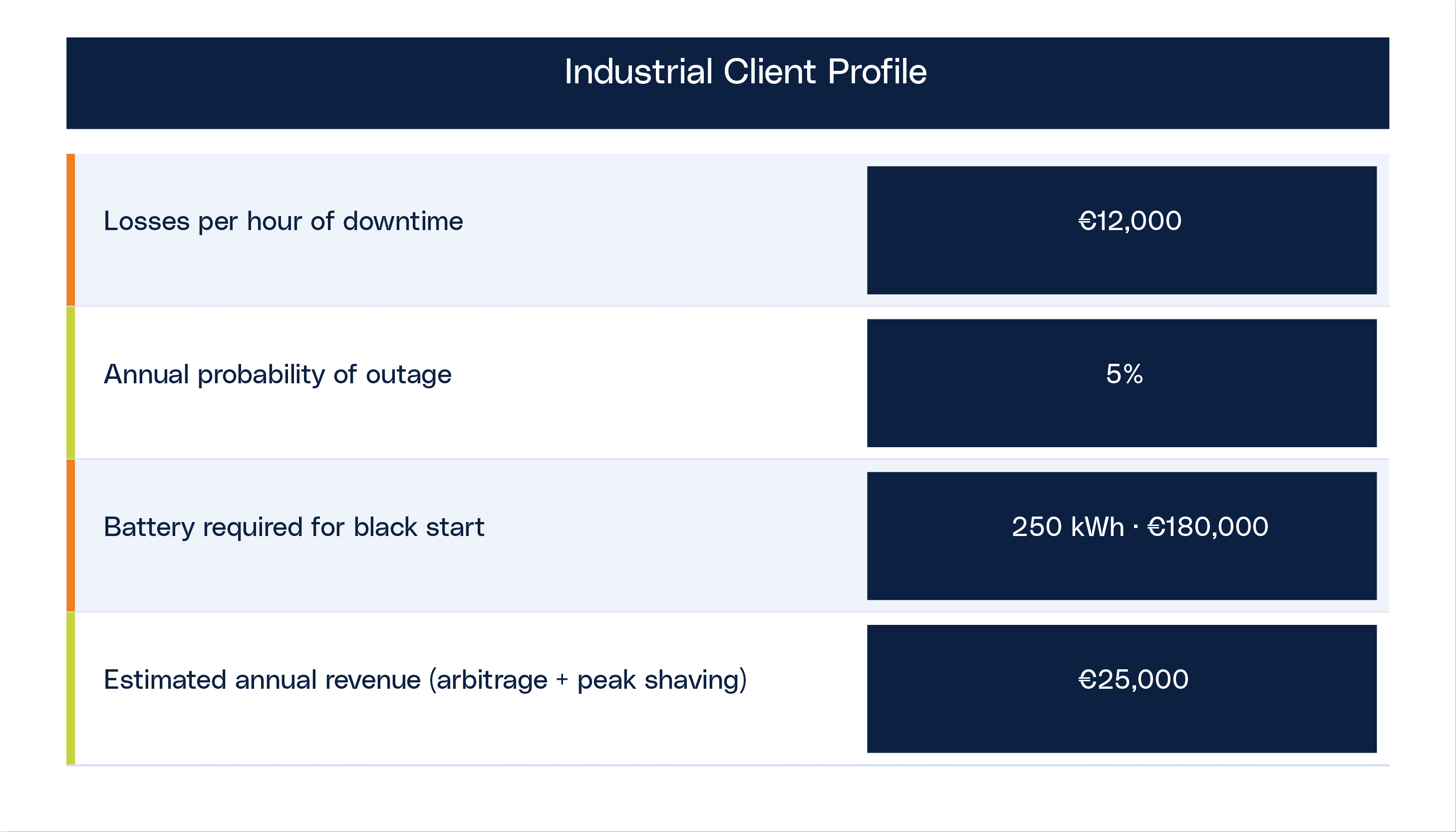
With this data, three scenarios emerge:
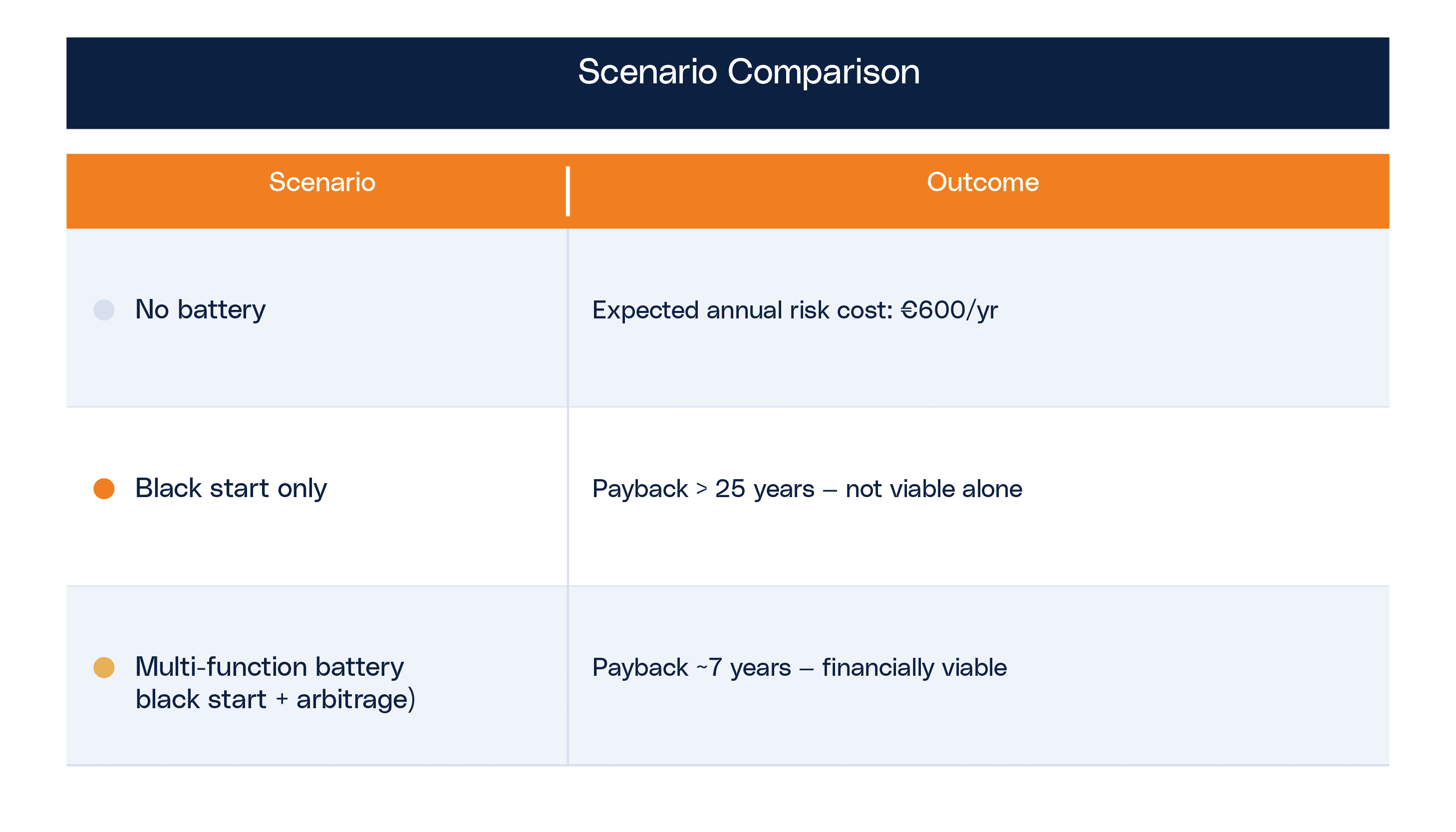
The conclusion is clear: a backup battery only makes financial sense when it is part of a broader strategy. Otherwise, it is a cost that is very hard to justify.
The best time to prepare for the next blackout is now, while the lights are still on.
The April 2025 blackout was a warning. But warnings are only useful if they lead to action.
Energy Management does not sell security as an inevitable cost. It helps companies understand exactly what is at risk, choose the right solutions for their profile, and turn investment in resilience into an asset that generates value, every day, not just in emergencies.